The Map is not the Territory
What oral assessment knows that AI has helped us remember
Colleen Ferguson · Executive Director · 15 May 2026
There is a particular kind of silence that follows a good question.
Not the silence of ignorance, or the blank look of someone who has nothing to say. This silence belongs to people who have put in real effort and believe they have reached a deeper understanding. And then someone asks them a question. The silence that meets it is the sound of someone thinking.
As a high school teacher, I’ve witnessed this silence many times and it is answered in one of two ways. The first is the gold standard of teaching and learning: the answer, when it comes, reveals conceptual depth and an appreciation for complexity. The student demonstrates mastery. The second has a slightly vertiginous quality, as if the student reaches for something they were certain was there and finds the shelf empty. The understanding they thought they had was, it turns out, more like a map of somewhere they'd never been. They read the map but didn't navigate the territory themselves, so they don't have much to say about it.
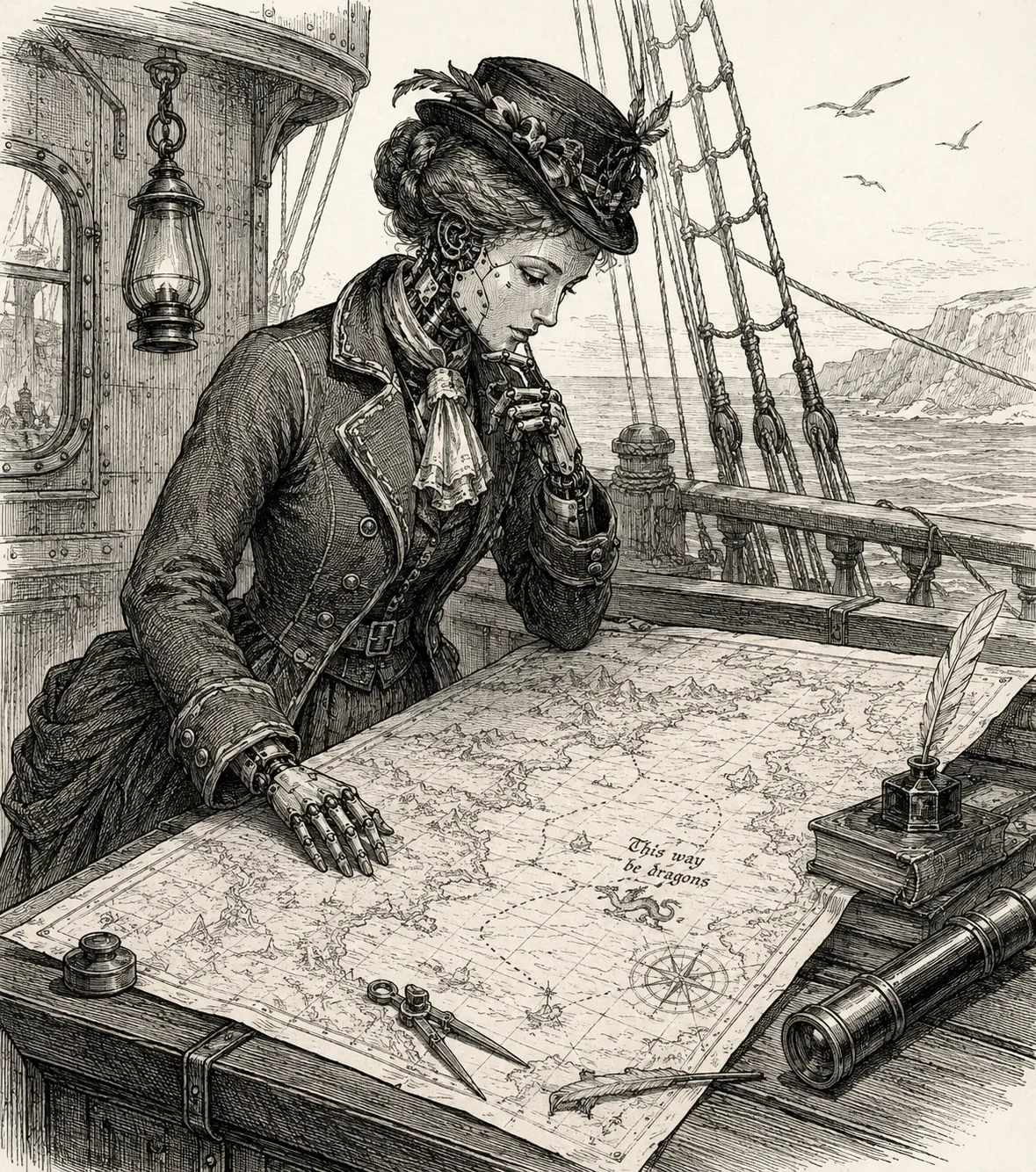
ChatGPT: “Automaton navigator studying a Victorian chart”
AI gives students the impression of mastery rather than deep learning. It provides the map so students think they don’t need to walk the terrain. Like many of my colleagues, I’m looking for ways to build productive effort back into learning, and I’m convinced that orality is one of them.
We recently played a game in my class. Students had just completed an outline for a 4,000-word research essay required as part of their IB Diploma. As a way to synthesise their ideas and hold the whole thing in their heads at once, they presented their paper to their peers in Just a Minute modelled on a BBC game show of the same name.
The trick of the game is that you present on a topic for 60 seconds without repeating, hesitating, or deviating. It’s far harder than it sounds. The students had 15 minutes to prepare. They could use their outline to rehearse, but had to do the full presentation without notes. Their classmates acted as judges.
It was a lively success, not only because 17-year-olds love a competition, particularly when they get to be judges, but because each student had to wrestle with representing a significant amount of work in a way that was accessible, interesting, and concise. They had to show what they knew through an authentic oral assessment. And in doing so, several of them discovered, some with obvious surprise, exactly where the shelf was empty. Where they didn’t walk the land and couldn’t remember the map.
Talking is not writing with your mouth. When you speak your understanding out loud, to another person, in real time, you discover what you actually know. Not what you can access with enough scrolling and searching. Not what you can assemble from good notes. What you have actually, genuinely, made your own. The question changes what you know. The act of reaching for an answer in front of someone, without a net, is itself a form of thinking.
This is old knowledge. Socrates used dialogue to teach. The medieval university assessed by oral disputation. The doctoral viva has persisted for centuries precisely because defending your thinking before another human being demonstrates mastery in a way no written product can replicate. What we have been doing for the last several decades — treating the written product as the primary, often the only, evidence of understanding — is the historical aberration.
AI forces us to reconsider that way of doing things, and to reconsider some older approaches. And perhaps some hybrid ones too.
The research on oral assessment is consistent: students who explain concepts aloud, who are questioned and must respond, demonstrate deeper retention and more flexible understanding than those assessed only on what they produce in writing. But I want to resist reducing oral assessment to merely an instrument for taking the temperature of learning that already happened.
What I find most compelling about oral assessment, done well, is that it is itself a form of learning. The student who stumbles on an explanation, who is asked “why?” and has to reach further, who corrects herself mid-sentence, that student is not just demonstrating understanding. She is deepening it.
Teachers working with large classes are already shaking their heads. A verification oral, a five-minute conversation after a written submission to check whether a student can explain what they apparently wrote, is useful: it addresses the immediate AI integrity problem. But it treats the oral as a secondary check on a primary product, and more importantly, it is almost impossible to resource. One-to-one conversations, five minutes per student, mean that a class of thirty or more would take days to assess. It also positions the teacher as auditor rather than interlocutor, which changes everything about what the conversation can do.
What I find more generative, and more capable of being deployed with large groups, are the formats where the conversation is the assessment, not an audit of something else: the seminar, the fishbowl, the Harkness discussion, the hot seat. Where the student’s job is to think out loud, in the presence of peers and a teacher. Where the teacher’s job is to listen carefully enough to ask the question that changes things.
Done thoughtfully, this can do something that written assessment almost never achieves: it can reveal the thinking of a student who could not otherwise express, or even realise, how deeply they understand.
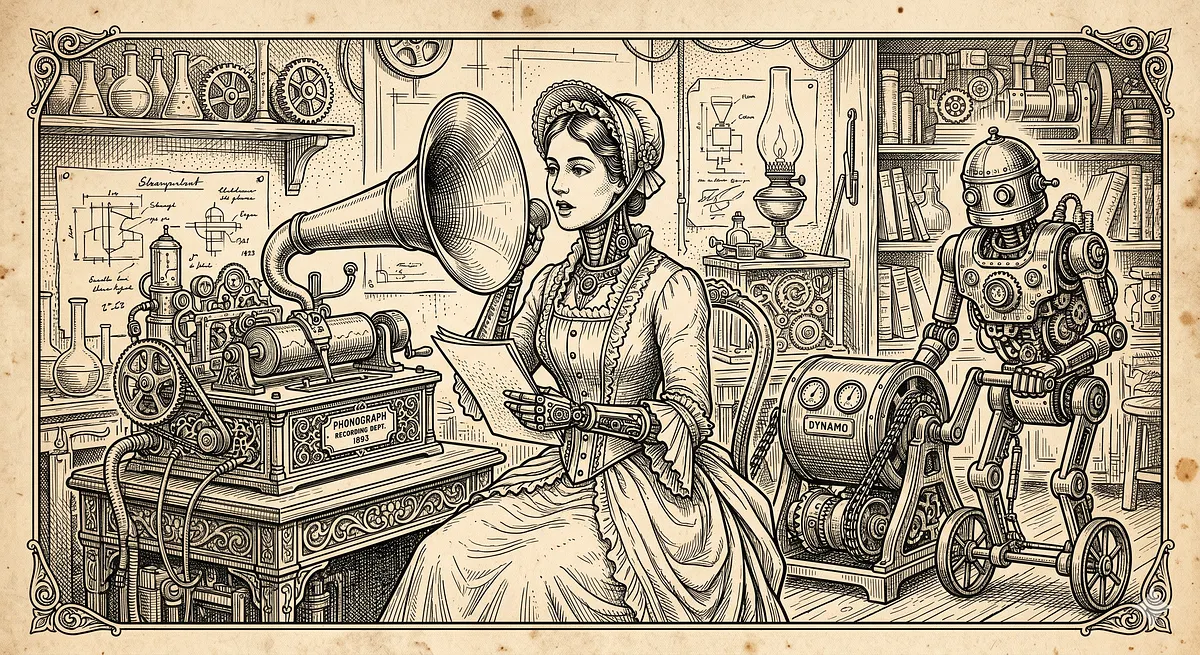
Gemini: "Victorian line drawing. A subtly robotic woman speaks into a steampunk recording cone, powered by a robot."
None of this happens without explicit design. Oral skills need to be taught and scaffolded. Students need rubrics and time to practise at low stakes. It is also worth making an unequivocal statement that accent and grammar are not what is being assessed. For students who are anxious about public performance, who are working in a language that isn’t their first, or who come from classrooms where speaking up was risky, oral assessment done carelessly can disadvantage the same students that written assessment already disadvantages. Done well, however, the opposite can be true: students who struggle to express themselves in writing can flourish.
There is also the question of what oral assessment asks of teachers. Listening is a skill, and it is not the same skill as marking. The examiner who is waiting for a student to confirm the answer already in mind is not listening. The examiner who notices a hesitation, follows a thread, and asks “can you say that a different way?” is doing something genuinely demanding.
Just like the students, we need practice. Reviewing examples of other teachers doing it well — or having a colleague sit in and offer feedback — can build the skill considerably.
AI can help here too — from AI-generated Harkness prompts to scalable large-group oral assessments, educators are exploring hybrid approaches that support human-to-human dialogue and make classical oral assessment possible in the modern classroom.
The oral tradition in education is not a workaround for a new problem. It is a very old technology. And perhaps it is exactly what we need most right now — not because it outwits AI, but because it asks something of a student that AI cannot answer for them. It asks them to be present, in their own thinking, in real time. To walk the territory and not just read the map.
Toward a Community of Practice
I’m currently taking Leon Furze’s Practical AI for Curriculum Leaders course. As part of the course, I combined my recent interest in orality with AI-assisted coding to build a slide deck designed to support teacher professional development on oral assessment. I’m sharing it here in the hope that it may be useful to others exploring similar questions around assessment, pedagogy, and AI.
I’m also working on an exciting project that I hope to launch soon — a platform dedicated to connecting educators through the exchange of thoughtful ideas and innovative practices. This slide deck is the first contribution to what I hope will become a collaborative community committed to reimagining teaching and learning together. More on that to come.
Teacher PD for Oral Assessments
Strategies, rubrics and research on using oral assessment to support student thinking in the age of AI.
Teacher PD for Oral Assessments (778KB ∙ PDF file)© 2026 Colleen Ferguson. Republished from Slantwise.