Sleight of Mind
Ten Moves to Keep AI From Stealing Productive Struggle (Part 1 of 2)
Colleen Ferguson · Executive Director · 14 July 2026
This slantwise brings a departure for me. I’m taking a break from my usual sort of post, and for two reasons.
The first is seasonal. For those of us in the Northern Hemisphere, these months bring some well-earned rest, but they also bring planning time for next year. In that spirit, this piece is meant to sit beside you while you do that planning. Over the next two slantwise posts I’ll offer ten teacher moves for building productive struggle into learning tasks. It’s more practical and less philosophical than what I usually write here, and that’s on purpose.
The second reason is one I’m really excited about. Together with some colleagues, I’m launching a platform for teacher collaboration as we navigate everything AI has brought into our classrooms. It’s called ThinkSlant. If slantwise is where I think out loud about all of this, ThinkSlant is where we try to build practical answers together. It’s a place to trade lessons that actually worked, to plan with tools designed for an AI-native classroom, and it’s a place to write up your thinking for a practitioner journal built by teachers, for teachers. This post is a sample of the kind of thing we’re making there. You can sign up for the newsletter at thinkslant.org if you’d like to follow along.
Opportunity for Productive Struggle
The trouble with AI – its whole seduction – is that it was built to make everything easy. Learning refuses to be easy. Learning is friction, effort, the productive ache of not-yet-knowing. Untrained and unguarded, students trust AI the way a mark trusts the crowd in a den of thieves: the struggle gets lifted, clean and quick, and what’s left in the empty pocket is cognitive offloading and deskilling.
Here’s how to catch the thief in the act. Choose a learning activity you’ve used before, something that asks students to do their own work. Now find the one crucial moment of cognitive struggle in it. The moment that usually produces the “Aha!” That moment is the prize. That’s what the AI is after. So ask yourself: could AI do the thinking that leads to that Aha? If the answer is yes, the learning is already at risk. The task needs to be redesigned. Build it so nothing can route around the friction. That friction is the point. Learning requires it.
The ten moves that follow are how we build productive struggle into learning and how we make the pocket impossible to pick whether or not AI ends up in the room.
The first five, the ones in this post, aren’t really about the task at all. They’re about the climate you build around it: the expectations, the vocabulary, the relationships, the habits students bring to the work before they’ve started the learning. Get the climate right and the tasks get easier to protect. In the next post, I’ll focus on the task itself, and about designing the kind of struggle that AI can’t do on a student’s behalf.

ChatGPT prompt “In the style of a Victorian line drawing, create an image of a automaton magician who is doing a trick but using the distraction to steal the wallet from the person who is watching her.”
Move 1: Value Process over Product
This year, I asked a student why he’d chosen to open his essay with a counterargument rather than his own claim. He couldn’t tell me. He had an excellent product and no memory of having made a single decision to create it. I had little recourse other than trying to catch unauthorised AI use because my course outline valued the products and not the process. That’s what this move is built to eliminate.
Building process benchmarks scaffolds skills and knowledge and it gives us room to support the executive-functioning work students so often struggle with: planning and organisation, task initiation, time management, and metacognition. Since we have plenty of data suggesting that AI is simply too tempting to resist for homework, it matters more than ever to build out those process steps, because that’s where teachers actually get to witness learning happen.
It’s hard to argue with the value of scaffolding an assignment. But teachers keep running into the same two problems: there isn’t enough time for multiple benchmarks in every assessment, and students don’t take the formative steps seriously. So I’m going to suggest two things. Reduce the overall number of assessments, and treat the process steps as summative. You’ll end up with more time to assess and more assessment data, not less.
Imagine you’re a grade 11 History teacher. Over the year, your students typically face six major assessments: two tests and four projects or essays. That gives you six major marks, and from those you derive an overall grade.
Now reduce that to four assessments: two tests and two projects. Each project has four steps, and every step is marked. The steps vary in scope and challenge, but each one is keyed to a learning outcome. Suddenly you have ten data points to build a grade from. And I’d go further: if the final product is the last mark, the earlier steps should carry more cumulative weight than the product does. Remember, what we choose to assess tells our students what we care about.
Move 2: Prioritise Live Learning
One of the more interesting findings buried in the very popular MIT Media Lab study on AI’s cognitive impacts is this: unfettered access to AI may not lead to deskilling or offloading if that access is delayed until after students have first engaged in AI-free learning. It’s an early, promising result rather than settled fact, but it’s promising enough to build lessons around. And the AI-free engagement it points to isn’t just any engagement. Students need to have dug in, elbows deep, into the hard thinking of a genuinely challenging task first.
So how do we make that happen in a classroom, short of having everyone write an essay under timed and secured conditions? We prioritise challenging learning experiences that unfold in real time. This is the stuff of your observation lesson, the one where you pull out every trick to show engagement to the person writing your performance evaluation. Socratic seminar. Debate. Experiential learning. Think-aloud problem solving at the board. Peer teaching and jigsaw. The genuinely fun stuff. Any of these can stand on its own as an AI-proof assessment, but if you’re heading toward something students will eventually do at home, plant these in the early lessons that get them there.
Another approach is to anchor part of a written assessment in something that actually happened in class. For example, you might ask students to weigh competing theories by writing an analysis of a four corners exercise you ran, drawing on their classmates’ contributions to support their claims.
You can also build synchronous elements into the work itself: one-on-one check-ins, peer assessment or peer editing. And through all of it, mandate metacognition. Asking students to reflect on how, or whether, learning occurred, and to point to specific examples, does two things at once. It buffers against unauthorised AI use, and it helps students consolidate the skills and knowledge they’ve just built.
Move 3: Provide Clarity about When and How to Use AI
In 2024, when teachers were still reeling from the arrival of ChatGPT, Leon Furze and his colleagues gave us the clearest and most celebrated tool for integrating AI into assessment. Its latest iteration is more nuanced, and it takes a genuinely future-ready stance toward the kind of ambitious student-teacher collaboration that’s now possible.
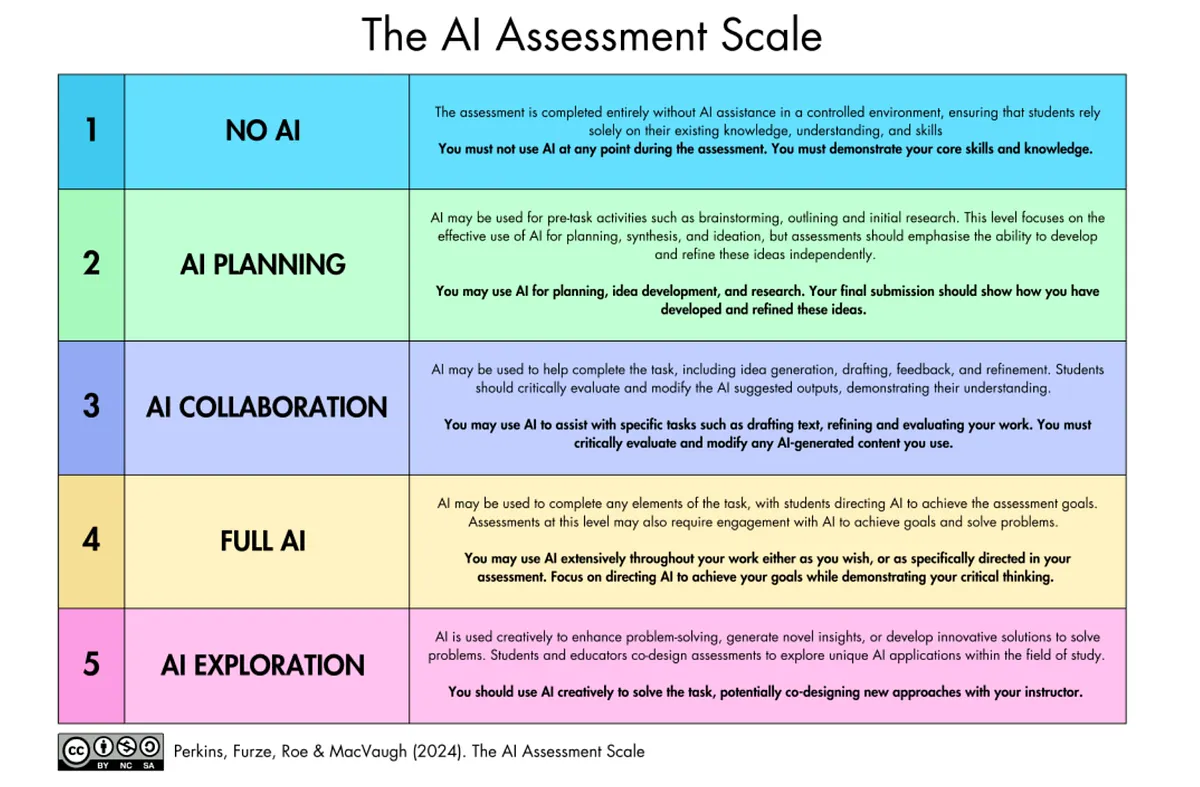
There are three important ideas behind this tool. The first is that we can no longer set an assessment without deciding when, how, or whether students will use AI to complete it. Pretending it doesn’t exist isn’t an option. Even if you don’t want it used, you have to say so. Second, tasks have to be designed so that AI use, or its absence, is intentional. If no AI is to be used, how are you actually building that into the lesson? And third, most importantly to my mind, the scale gives everyone a common vocabulary which is essential to building clarity and trust between teachers and students.
Picture the student halfway through an assignment genuinely unsure whether she’s allowed to ask GenAI for feedback on her draft. According to a UK study, an overwhelming number of students report that they are frequently unclear on whether AI is or isn’t allowed for a given assessment. They’re asking for guidance on how to use it appropriately in their particular context, and they want to know how to avoid deskilling and offloading. So whether you reach for this AI Assessment Scale or another model, the imperative is the same: speak about AI often, and be clear about how, when, or if it’s allowed. And be explicit about what counts as good practice and isn’t. Every. Time. You. Assess.
Move 4: Eliminate Gotcha Culture around AI Use
I’ve written before about Gotcha Culture and the effect AI screening tools can have on students. Since then I’ve completed an Action Research Project for the International Boys’ School Coalition on using process-oriented strategies to mitigate AI dependency, and my thinking on how culture shapes AI use has deepened.
When we treat AI screeners as a game of catch me if you can, we risk two things: pushing unethical use underground, and, worse, reinforcing the idea that all AI use is wrong. If screeners are used at all, they have to sit inside a system of accountability guardrails — process benchmarks and the like — designed to open up conversation about AI use rather than shut it down. A screener flag can be one data point in the work of verifying learning, alongside an oral viva voce or a student’s rough notes. It cannot be the only measure of ethical AI use.
The screener’s fallibility can itself become interesting learning. Why are these tools sometimes wrong? How do they work? What kind of language gets flagged? Run a pre-AI-era paper through the screener as a class and see whether it trips. Run another and compare. Students come away understanding a good deal more about how the technology works. And if they’re preparing work for external assessment, say for the International Baccalaureate, it’s genuinely useful to run it through a screener beforehand to anticipate any questions about authenticity. That reframes the screener as a learning tool rather than a policing mechanism.
Long before Reichert and Hawley told us that positive relationships were the key to learning, we teachers already knew it. When students view their teacher as an ally rather than an adversary, they are far more likely to be honest about how they worked. A screener can flag a document. It cannot build the relationship that makes a student want to tell you the truth about how they wrote it. That relationship is the real accountability guardrail, and no piece of software has ever replaced it.
Move 5: Expect and Model AI Transparency
Students and teachers should talk about AI often: the good, the bad, and the ugly. And teachers should do this whatever their personal position happens to be, challenging themselves to be as objective as they can manage. Our students are walking into a world where this technology will touch everything. Simply telling them it’s bad doesn’t help them navigate that future ethically or productively. Embracing it without critical interrogation risks leaving them naive about its impacts.
Most importantly, we teachers need to demand of ourselves the same transparency we expect of our students. Depending on age, should be talking with our students about whether AI can or should provide feedback. Whether it’s acceptable to use for report cards. Or emails. We spend a lot of time telling students about what is off limits in their work when it comes to AI. Let’s invite them into conversations about our work. I think their ideas will be great for creating a set of principles to guide the class: what must be human created and can be co-created with AI, and why.
If we use AI to help plan our lessons, build our slides, or draft our feedback, we need to say so, in age-appropriate ways. I’ve lost count of the times I’ve attended teacher-training presentations where a slide carries an obviously AI-generated image with no citation at all. If you use AI to produce images, please hold yourself to the same standard that you expect of your students and cite! Even a tag at the bottom that says “This slide was co-created with AI” is a move towards a more transparent and judgement free culture.
We also need citation methods that are realistic and that actually reflect what AI is. I’m frustrated by how many AI policy documents insist that student AI use “must be cited” without reckoning with its ephemeral nature. That treats an AI exchange as though it were the same as a book on a shelf. Instead, students should keep AI logs, recording and reflecting on their use across a project: the prompts they tried, and an honest evaluation of whether the interaction actually helped. AI logs increase transparency and, almost as a side effect, ignite metacognition.
The Crowd, the Distraction, the Mark
Notice what all five of these moves have in common. They change the environment the task lives in: what we count, what we say out loud, whom students trust, and the habits they carry into the work before the work begins.
What does a pickpocket need? A crowd to disappear into, a mark whose attention is somewhere else, and a split second when the hand is already in the pocket. Take those away and there’s no lift. That’s what these five moves do. A classroom with real trust has no crowd to hide in. A classroom with real transparency offers no distraction to work behind. A classroom that pays attention to process leaves no mark looking the other way. And a thief who’s being watched, closely, the whole time, can’t work the con at all. None of this redesigns the friction. It just makes the friction much harder to slip past. Get the culture right and you’ve stripped AI of every condition its sleight of mind depends on.
In Part 2, we turn to the task itself, and to what it takes to build a struggle that AI genuinely cannot steal.
© 2026 Colleen Ferguson. Republished from Slantwise.