If You Could Print Money, Wouldn't You?
Why AI cheating is a design problem, not an ethics one
Colleen Ferguson · Executive Director · 15 March 2026
Every student now has access to a counterfeit printer.
It’s free. It’s instant. It produces something that looks, on the surface, almost exactly like the real thing. And it has exposed something schools probably should have noticed sooner: we built our entire assessment system on the assumption that the currency — essays, lab reports, homework and every other learning product — was hard to fake.
It wasn’t, really. Students have always found ways to cut corners. But AI has made counterfeiting so frictionless, so available, and so good that the old economy can no longer hold. And the instinct of many schools to build better walls, mandate handwritten exams, and run everything through detection software, is understandable. It’s also the wrong response. You can make counterfeiting slightly harder. You cannot make it hard enough. Not anymore.
The real question isn’t how to protect the currency. It’s whether we should be running this economy at all.
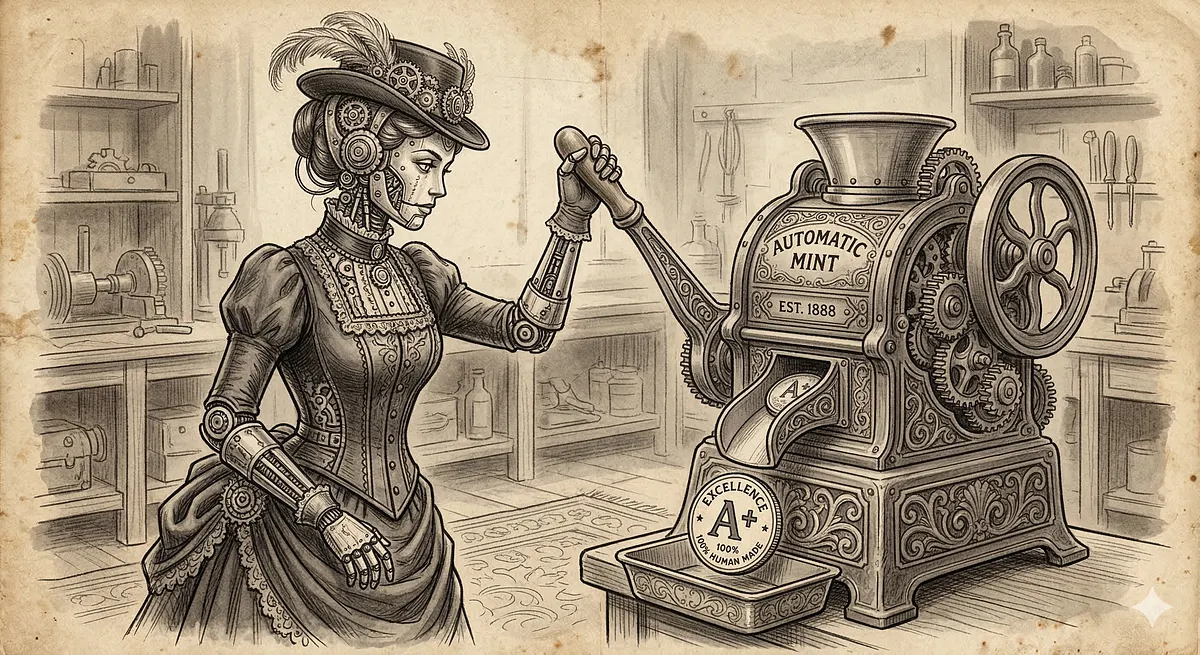
NanoBanana A Victorian lady, who is actually a robot, pulling a level that produces a coin with an A+ on it. The small text on the coin says, 100% human made....
Teaching Ethical AI Use is Not Enough
Here’s what makes this complicated. Most students aren’t confused about the ethics. They’re not looking for loopholes because they misunderstand the rules. After two years of teaching an AI literacy curriculum and surveying the students who came through it, what I found was not ignorance. It was something much more interesting.
They get it. Completely. They want to learn and they don’t want AI to steal learning opportunities from them.
I’ve repeatedly asked students what they’ve learned about using AI ethically in my course. Their responses could have been written by educators:
“AI is a tool we can use to learn. It is NOT a tool we use to learn for us.”
“Whenever I want AI to help me with an essay, I explicitly ban it from writing any essay snippets or ideas for me.”
“I will question myself when I am using AI to see if I am offloading work that is important to my development as a learner.”
They understand the risk AI poses to their own learning. They feel the pull toward authentic thinking. They can articulate, with impressive precision, exactly where the ethical lines are.
And then, at 11pm the night before a deadline, they cross those lines anyway.
This isn’t a knowledge problem. It’s a human one. And no amount of AI literacy curriculum, including mine, fully solves it.
The Knowing-Doing Gap
When I looked more carefully at the students who crossed their own ethical lines, I didn’t have to look far. This past year, a small handful of students used AI unethically on a final written assignment. I knew because the assignment had been built around process. There was a lesson that produced a short opening paragraph. A graphic planner. A conversation about the planner. A draft with feedback. And then the final product.
In two cases, the final product was unrecognisable from everything that had come before it. In the third, two of the middle steps were simply missing; the student had vanished from the process and reappeared only at the deadline, under pressure from home.
I met with each of them individually. No disciplinary hearing. No accusation. Just a conversation.
They all admitted it. Almost immediately. And what struck me most was that they seemed, in some strange way, relieved to have been caught.
The two who had completed the earlier steps weren’t lazy or indifferent. They were terrified. They didn’t believe that what they could produce on their own would be good enough. The process work was genuinely theirs but at the final moment, confidence failed them. The third had procrastinated himself into a corner so tight that AI felt like the only way out.
Two different problems. The same solution. One that was right there, frictionless, and free.
What I told all three of them was this: the consequence wasn’t a grade penalty. It was a learning penalty. By handing in work that wasn’t theirs, they had skipped the only part of the assignment that actually mattered, the part where their thinking got better. And because we had spent so much of the course talking about exactly that, they understood it. They owned the mistake. They redid the work.
That’s not a story about cheating. It’s a story about what happens when students don’t yet have the skills to manage pressure, doubt, and time and when a counterfeit printer is sitting right there on their desk.
Products Are Currency
Schools, if we’re honest about it, run like economies. Essays, lab reports, presentations — these are the currency students trade for grades, and grades are the currency they trade for futures. Learning, in this model, is the labour required to mint the coin.
AI has changed that completely. Not by making students lazier or less ethical, but by handing every single one of them a counterfeit printer. Free. Instant. Infinitely capable. And good enough that most people can’t tell the difference.
When we respond to this by building better walls by locking down browsers, mandating handwritten exams, running submissions through detection tools, we’re not solving the problem. We’re just making counterfeiting slightly harder. The economy itself remains intact. The incentive remains intact. And students, who are nothing if not resourceful, will find a way.
The uncomfortable truth is that schools created the conditions for this. We decided that what mattered was the product. We designed systems to assess it, rank it, and attach life consequences to it. We told students, in every structural way possible, that the destination was what counted. AI didn’t corrupt that system. It exposed it.
So the answer isn’t better detection. It isn’t more sophisticated assignments AI supposedly can’t do. The answer is to devalue the currency.
Process Is the Point
We need to shift the weight of assessment away from the product and onto the process: the incremental, visible, unglamorous work of actually learning something. Not as an add-on. Not as a soft alternative for students who struggle with tests. As the main event.
This costs something real. It means fewer assessments, because rich process takes time. It means stealing hours away from marking final products and reinvesting them in progress checks, drafts, reflections, and conversations. It means a course that used to include four major projects might only have two but those two will be genuinely witnessed, genuinely understood, and genuinely hard to fake.
It also means rethinking how we weight grades. If an essay has always been worth 20% of a term, consider awarding 15% to the process -- the planning artefact, the research benchmark, the draft, the reflection — and 5% to the final product. Not because the product doesn’t matter, but because it’s only one data point, and we’ve been treating it as the only one that counts.
And here’s what this gives back: when the process is the point, the counterfeit printer becomes almost useless. You can’t outsource the thinking if the thinking is what’s being assessed.
There’s something else it gives back too. When assessment is spread across the process, the stakes at any single moment become manageable. The student who’s running out of time has a progress check tomorrow, not a final deadline. The student who doubts herself has already handed in a plan, received feedback, and survived it. The conditions that drive students toward AI in desperation begin, slowly, to change.
This doesn’t solve everything. Students are human. They’re under pressure in ways that extend well beyond any single classroom or curriculum redesign. But it moves the conversation to the right place — away from policing what students produce, and toward supporting how they learn.
Learning as Assessment
My students already know how to be ethical. That’s what the data shows, and I believe it. They’re not waiting to be taught the rules. They’re waiting for a system that makes following the rules feel possible.
They aren’t bad kids making bad choices. They are capable people who ran out of time or ran out of faith in themselves, and reached for the easiest thing available. What made the difference wasn’t catching them. It was that the process work was already there, a record of their thinking, visible and real, so the conversation didn’t have to be adversarial. We could just look at it together and ask: what did you skip, and how do we go back for it?
That’s what process-centred assessment makes possible. Not just better detection of AI misuse, but better conditions for the honest conversation that has to follow.
The counterfeit printer isn’t going away. If anything, it will get better and harder to detect. We can keep building walls around it. Or we can ask what we were really trying to protect in the first place.
Learning isn’t a product. It never was. It’s the crooked road of struggle, mistake, revision, and gradual understanding. It’s the process we’ve been rushing past on the way to the grade. But you can’t outsource the thinking if the thinking is what’s being assessed.
Andy Hargreaves once warned that we risk valuing only what we can measure, rather than measuring what we value. AI has made that warning urgent in a way he perhaps didn’t anticipate. It has handed every student a way to produce the measurable thing without doing the valuable thing.
If we value thinking, we must give thinking value.
© 2026 Colleen Ferguson. Republished from Slantwise.