Ban the Bans
The reflex to ban AI is understandable. It's just not a strategy.
Colleen Ferguson · Executive Director · 18 September 2026
In The Wizard of Oz, when Dorothy finally speaks to the wizard to ask for help for herself and her friends, the Great and Powerful Oz ignores the request and sends the group off on a dangerous errand to serve his own needs. It turns out that Oz, nothing more than a mechanical projection, is not so great or powerful, and is, in fact, selfish, arrogant, and mean.
I am reminded of that movie as I consider our current great and powerful (and scary) technology and how there is a growing concern that AI increasingly feels like the wizard: arrogant, bombastic and cruel. That it, as a proxy for a handful of tech companies, is giving us parlour tricks to distract us while it goes about its self-serving business.
I’m not alone. The AI backlash is here. It started in the spring with tone deaf convocation speakers extolling a bright AI-infused future, only to get booed by graduates worried it is eliminating the jobs they’d just spent years (and thousands of dollars) training for. Then there was news about an increasing number of small towns successfully fighting off proposed data centres – a David and Goliath moment that shocked tech companies who were surprised to discover that cash infusions wouldn’t ensure that they got their way. The sense of antipathy increased in the summer as more people noted increasing signs of an AI bubble and commentators started floating the possibility that if we don’t regulate we should at least slow down.
I’ve been having my own AI fears. The Hugging Face incident rattled me, particularly after learning that the breach was likely just one of many, and the number of high ranking AI execs who are sharing their worries about the pace of development is enough to make anyone at least a little concerned. What is it, exactly, that we are running headlong towards?
The reflex to fear is action. By summer’s end, two of this continent’s biggest school districts, New York and Los Angeles, banned AI in classrooms and on school devices. Chicago may follow pending the election results. In some ways, it’s understandable; a ban is a tangible response to feeling overwhelmed. It’s the adult version of covering your ears and screaming “Stop!” Since AI arrived in our schools in 2022, we’ve gone from bans, to adoption, and now, it appears, back to bans.
But what have we learned in the intervening time?

ChatGPT prompt: In the style of a Victorian line drawing an automaton teacher leads an engaged class with “How to ask good questions” on the board behind her.
Well, for one thing, I’d have hoped we’d learned that we can’t turn back the clock to the pre-AI world because we know that a ban cannot stop students from using AI. Companies have been working at breakneck speed to incorporate it everywhere and AI is in everything from toasters to teddy bears. I am writing this in Google Docs and all I have to do is press a button called “Help me write” to get Gemini to compose and edit for me. Anyone who’s recently tried to do a simple internet search but gotten an AI oracle instead, knows they can’t get away from the stuff. How do you ban something that is ubiquitous and almost impossible to avoid?
Not allowing AI on school devices or in class will not stop kids from using it in their assignments and homework. Back in 2023, when many schools were banning AI the first time (including NY and LA), the Pew Research Center found that 1 in 5 U.S. teens were using it for schoolwork. That share roughly doubled by early 2025, and this year, 54% of U.S. teens say they use a chatbot for schoolwork help, with 10% doing “all or most” of their schoolwork that way.
I understand the impulse to ban a technology that is transforming education at a breakneck speed because we’ve been here before and we got it wrong.
In the 2010s when schools adopted 1:1 device programs and learning management systems and kids started arriving at school with smart phones in their backpacks, the issue wasn’t just that students had access to tech, it’s that we ran headlong towards adoption before teachers were given a chance to figure out how teaching and learning needed to shift as a result.
I know that much has been made of the recent PISA results. I also know that there is no proven correlation between the arrival of digital technology and the commensurate decline of literacy, numeracy and science scores. But every educator knows in their bones that something shifted when most students started learning behind a laptop and when they replaced reading with scrolling. We already know what happens when we let big changes reshape classrooms without asking hard questions first.
The reflex to ban is understandable, but it’s not a strategy. Neither is its opposite. Shrugging and adopting AI wholesale, or embracing every AI-ified edtech do not consider how the technology is changing our learners. AI is particularly adept at smoothing out the rough bits of thinking and writing. So if “easy” becomes our status quo, how does a 15-year-old acquire the mental grit to figure out a quadratic equation or a paragraph of James Joyce? We can’t protect them with gated learning software because AI has infused everything. Like two decades ago, we aren’t considering enough how technology changes the person using it.
Perhaps a middle path is the answer: innovation in teaching and learning that supports human-centred AI use, or what I call AI-native education. This could include systemic support for teachers and students to understand and critically engage with the technology, and approaches to learning that include learning literacy alongside AI literacy so that students can protect their learning when using a technology that undermines it.
In The Reverse Centaur’s Guide to Life After AI, Cory Doctorow argues that the bubble, job losses, and the proliferation of data centers trace back to a financial logic that needs the technology to look inevitable. Somewhere behind “it just has to be this way” is somebody who decided it should be and somebody who stands to gain. Similarly, the fight over data centres is not about whether AI is useful or scary, but whether the people living with its consequences ever got a say in how it impacts them.
Empowering students to ask who decided this, who benefits, and who wasn’t consulted might happen under a ban, but it is much less likely. Instead of hiding the tool, you teach students to look at it clearly and critically. You consider the context of its arrival, support them to ask good questions about who benefits and who loses, and you teach them to use it in ways that don’t undermine their learning. You can’t show a student what’s lost when struggle gets skipped if you never let them see the skipped version. That contrast has to be visible and discussed, not assumed. A teacher willing to let students try a task with AI’s help and without it, then ask what they noticed, is doing something no ban could ever accomplish.
Protecting the struggle that learning requires is precious, painstaking work, and it’s exactly the innovation an AI-native classroom makes possible. When we support teachers to make this shift, they equip young people with agency in a world designed to keep them passive.
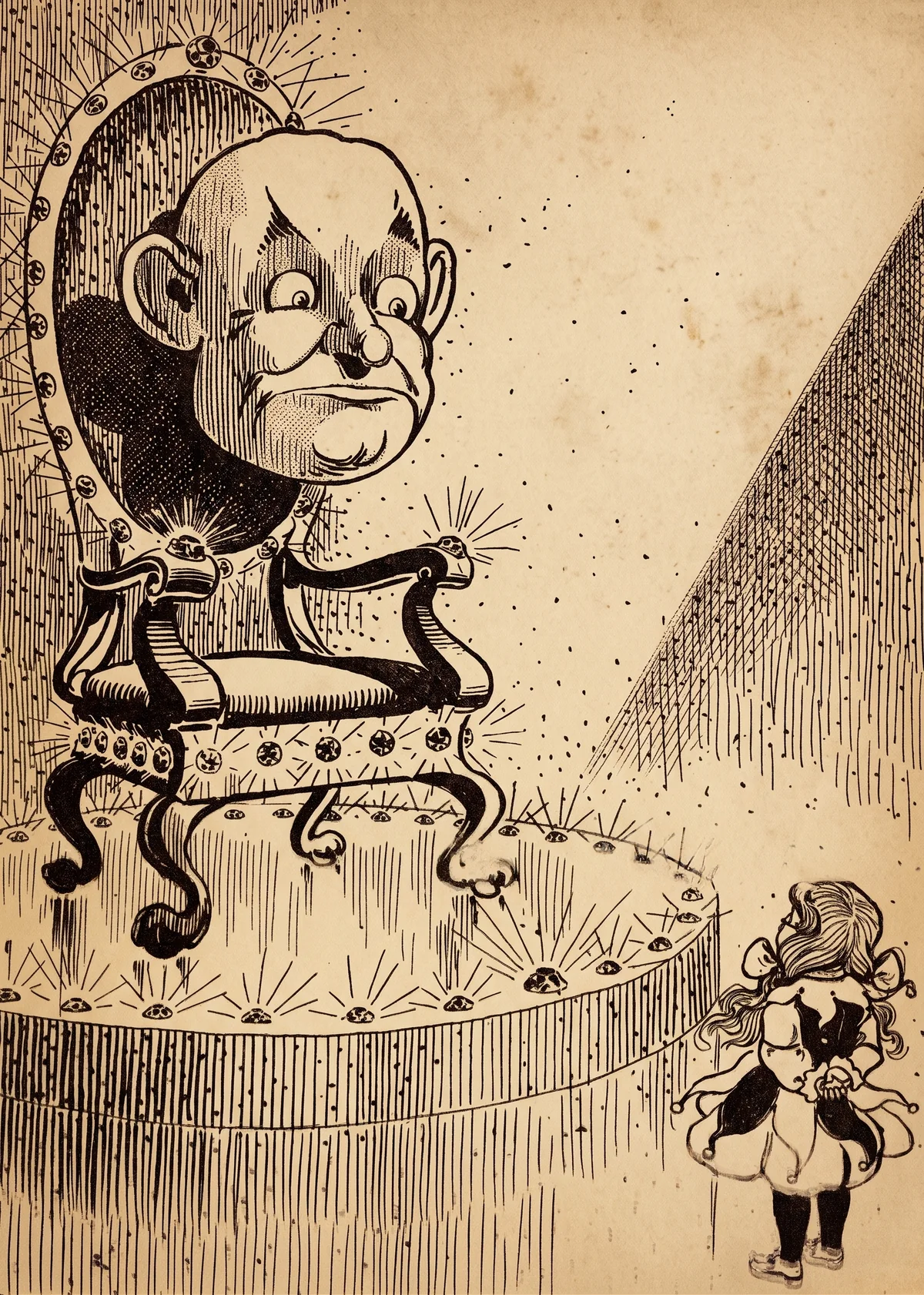
The clichéd interpretation of The Wizard of Oz cautions us to be wary of smoke and mirrors and be aware of the man behind the curtain, but I think the lesson is a bit more nuanced.
When Dorothy and her friends return with the witch’s broom, the wizard obfuscates in a thunderous voice, spews columns of fire and flashes the lights. Dorothy sees through the diversion and says “If you were really great and powerful, you’d keep your promises!”
She speaks truth to power and power crumples.
When Toto pulls back the curtain, the man and the central paradox are revealed. The machine appears omnipotent, but isn’t. The man appears weak, but is empathetic and wise. After all, it is the man who teaches Dorothy and her friends that they already have what they are seeking inside of themselves.
In a human-centred, AI-native education we support our students in knowing that they have what they need inside of themselves. We teach them to think critically and ask informed questions. We show them that they have agency, and we allow them to believe that no matter how dire the news, the future isn’t something to consume passively. It’s something they get to shape into what they value, not what they’ve been told to want.
Because Dorothys are not born, they are taught.
To get a better sense of the current criticism facing AI at the moment I sought out a lot of information. I found a range of interesting material but was primarily influenced by three sources: Cory Doctorow’s new book, The Reverse Centaur’s Guide to Life After AI, The AI Doc: Or How I Became an Apocaloptimist by Daniel Roher and Charlie Tyrell, and two Ezra Klein interviews The A.I. Revolt is Here with Jasmine Sun and The A.I.s Are Already Out of Control with Helen Toner.
To support teachers who want to explore the AI backlash with their high school students I’ve developed a mini unit that will be posted on the ThinkSlant Lesson Exchange in the next few days. It will cover current discussions on AI safety, regulation and backlash and invite students to become active, engaged citizens and critically thoughtful AI users.
© 2026 Colleen Ferguson. Republished from Slantwise.