AI Literacy is Not Enough: We Need AI-Native Education
Learning to See the Water
Colleen Ferguson · Executive Director · 26 April 2026
In his 2005 commencement address to the graduates of Kenyon College, David Foster Wallace told a joke that wasn’t really a joke. An older fish swims past two younger fish and calls out, “Morning, boys! How’s the water?” The young fish swim on. After a moment, one turns to the other and asks: “What’s water?”
Wallace’s point wasn’t about fish. It was about the purpose of education which he argued was not the accumulation of knowledge or the credentialing of competence, but the cultivation of awareness. The ability to see what surrounds us so completely that many of us have stopped seeing it at all.
I’ve been returning to that image as AI seeps deeper into our classrooms, our assignments, and our students’ habits of mind. Because I think we are the fish. And AI is the water.
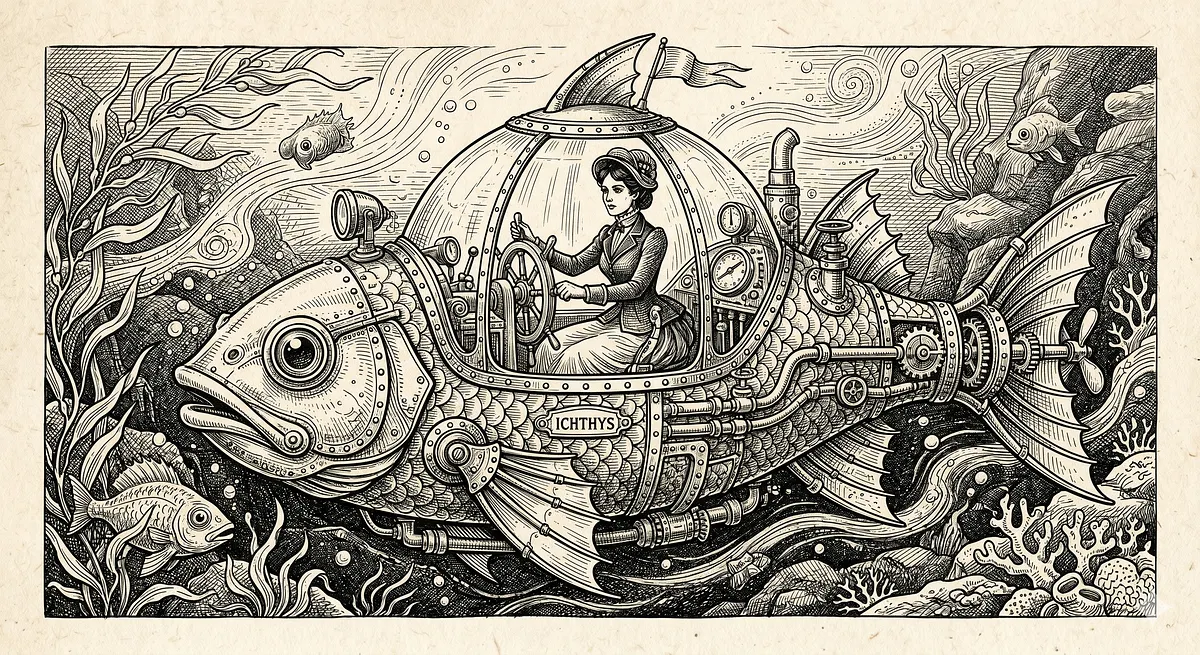
Gemini prompt: Create a Victorian era line drawing with a woman driving a submarine shaped like a fish.
The Fish Don't Know They're Wet
The dominant educational response to AI has been AI Literacy: teach students to prompt effectively, to interrogate outputs, to understand bias and sycophancy and environmental cost. Teach them when AI helps and when it harms. Give them the framework, and trust them to use it wisely.
This is not wrong. I’ve built a version of it myself. But I’ve come to believe it isn’t enough, and that the gap between what it addresses and what it misses is exactly where the most important learning is happening, or failing to happen.
AI Literacy treats AI as a subject. What I think we need is something closer to what Wallace was pointing at: an education that changes how students understand themselves as learners, in a world that has been quietly, fundamentally, altered.
We’ve been here before, and we didn’t quite get it right.
When smartphones and social media arrived, we responded with Digital Literacy. We taught students to evaluate sources, spot misinformation, protect their privacy online. All necessary. But the most profound effect of that technology wasn’t what students were doing with it — it was what it was doing to them. Hana Lee Goldin recently wrote about this in Card Catalog. Attention spans shortened. Deep reading faltered. In the United States, reading and math scores among thirteen-year-olds peaked around 2012 and have declined steadily since.
We noticed. We lamented it. We assigned more books and wondered why students weren’t finishing them but we didn’t ask the harder question: what does it mean to teach reading — really teach it — to students whose entire relationship with text had been transformed? We kept handing them the same books, and they kept reaching for their phones, and we called it a motivation problem instead of a design problem.
I think we’re at risk of making the same mistake again.
Teaching the Swimmer, Not the Water
AI Literacy, even done well, tends to address the direct impacts of AI: the cheating, the deskilling, the uncritical acceptance of generated content. What it doesn’t yet grapple with is the indirect impact — the subtler erosion of a student’s belief that struggle is worth it, that their own thinking has value, that the crooked road of genuine learning leads somewhere worth going.
Eric Hudson, in Learning on Purpose argued that the arrival of AI makes our existing learning goals such as judgment, critical thinking, self-awareness, self-regulation, not less important, but more. The problem is that many of the tasks we’ve used to assess those goals are no longer reliable proxies for them. The task and the goal have come apart.
This seems to me exactly right. And it points toward what I’d call Learning Literacy, not teaching students about AI, but teaching them how to learn in a world shaped by it. Helping them understand their own minds: how attention works, how struggle produces growth, how motivation operates, how to notice when they’re reaching for AI out of fear or fatigue rather than genuine need.
In practice, this means designing differently from the start.
It starts with live learning which is a celebration of human learning: shared, experiential, and collaborative. No one is talked at. No one is passive. Students are already inside the work before they're ever asked to do it independently. By the time a student sits alone with a task and an AI tool, they are already elbow-deep in their own thinking. The ideas are theirs. The questions are theirs. AI enters a process already underway, rather than substituting for one that never began.
It means sequencing with motivation in mind. Not just asking whether a task is interesting, but asking why a student would care enough to do the thinking themselves. When the answer is unclear, AI becomes the path of least resistance. When the answer is genuine, students often don’t want AI to take it from them.
And it means designing tasks ambitious enough that AI’s presence changes the texture of the work rather than replacing it entirely. If a student is applying a theoretical framework from economics to a real problem in their school — the food in the cafeteria, the equity of the timetable — AI can support that work without doing it. The thinking that matters is still theirs to do.
Wallace was speaking to graduates in 2005, before the iPhone, before social media, long before any of this. What he was asking them to guard against was an unconscious absorption into the self and the blinkered assumption that the world exists to serve your immediate experience of it. Education, he believed, was the antidote: the slow, difficult cultivation of awareness of others, of context, of the water you’re swimming in.
That project feels more urgent now, not less. Because AI has made it extraordinarily easy to outsource the very thinking that builds that awareness. To skip the struggle. To arrive at an answer without ever having had the question live inside you long enough to do its work.
Teaching AI Literacy helps students use the tool. But the work Wallace was pointing at is protecting the human being doing the using. AI-Native education doesn’t ask students to resist AI or fear it. It supports them to remain themselves inside it: curious, capable of struggle, able to tell the difference between thinking they’ve done and thinking that’s been done for them. That’s not a small thing. In this moment, it might be everything. In fact, it’s the water we’re swimming in.
© 2026 Colleen Ferguson. Republished from Slantwise.